
What the law says - demystifying what's true and what's false
Heating oil - practical information
There's a lot of information and rumours circulating online about heating oil, but what does the law actually say?
On this page, you'll find a wealth of practical information about heating with oil: the laws in force, an explanation of the cost per liter, the main factors influencing the price, etc.
Composition of heating oil prices
Quebec price explanation
Contrary to popular belief, the difference between the price of heating oil at the ramp and the price paid by the consumer does not correspond solely to a profit margin.
In Quebec, the government imposes a tax on all petroleum products, including heating oil (mazout), even when used for domestic and off-road purposes.
GST and QST apply.
Factors influencing price per liter
From geopolitics and seasons to market competition
Geopolitics
Geopolitical tensions, weather and wars have a direct influence on the price of heating oil. Derived from petroleum refining, fuel oil is a product very similar to the diesel used in road trucks.
Here's a concrete example: the end of Russian oil imports in 2022 has had a major impact on the cost of a barrel of oil worldwide, which has been directly reflected in the price per liter of heating oil.
Conversely, in a hypothetical scenario where geopolitical tensions with Russia ease, the price of fuel oil could fall, as the market becomes larger and more stable once again.
Competition
In recent years, the number of households using heating oil to heat their homes has fallen considerably. This has resulted in higher transportation costs, given the greater distance between customers.
This drop in demand forced distributors to compete fiercely in a shrinking market, resulting in much lower heating oil prices, much to the delight of consumers.
Refining
The role of refining in fuel oil prices
As mentioned above, heating oil is derived from the refining of crude oil. Its price is therefore directly linked to the world price per barrel. But we mustn't forget another factor: the location of refineries. The closer a refinery is to the point of delivery, the lower the transport costs - and therefore the lower the final price for the consumer.
Montreal, from a hub to a single refinery
A few decades ago, Montreal was a major oil refining hub, with several refineries in operation (BP, Esso, Shell, Petro-Canada). But with successive closures, the metropolis lost this status. Today, only one refinery remains in operation in the Greater Montreal area: the Suncor refinery, located in Montreal East, which processes around 137,000 barrels a day.
The role of the Valero refinery and the Saint-Laurent pipeline
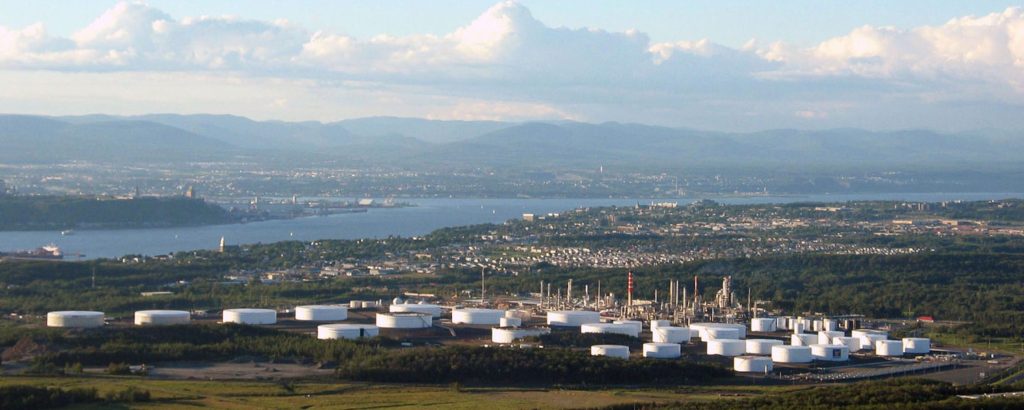
In addition to Suncor, a significant portion of the fuel oil consumed in Montreal comes from Valero's Jean-Gaulin refinery in Lévis, near Quebec City. This facility is the largest refinery in the province, with a capacity of 265,000 barrels per day. Its products (diesel, gasoline, fuel oil, jet fuel) are transported to Montreal via the Saint-Laurent pipeline, commissioned in 2012. Interestingly, this is the last pipeline to be built in Quebec.
Exchange rates
Crude oil is traded in U.S. dollars (USD). The Canada-U.S. exchange rate therefore has a direct impact on the price of heating oil per liter in Quebec and Canada.
When the Canadian dollar is weak against the U.S. dollar, the price of fuel oil is higher for Quebec consumers, because it costs more to import and refine.
High and low season
The price of heating oil varies greatly according to the season. In high season, i.e. autumn and especially winter, demand explodes as thousands of Quebec households heat their homes with oil. This pressure pushes up the price per liter, especially during cold spells when delivery logistics become more costly and sometimes complicated by storms.
Conversely, in the off-season (spring and summer), consumption drops and distributors often offer better rates, sometimes even pre-order discounts to encourage customers to fill their tanks before winter.
That's why it's generally more advantageous to order your heating oil in summer than to wait until the depths of winter.


Oil heating law - Heating oil in Montreal
What can I do?
Regulations for the island of Montreal
Contrary to popular belief, oil heating is not banned in Montreal or Quebec. The new laws mainly affect the installation of new appliances: it is no longer permitted to install a new oil furnace in a new house, and you can no longer replace an old appliance with a new one that runs on oil.
On the other hand, if you already have a system, you have every right to continue using it, repairing and maintaining it, and even upgrading certain components to make it more efficient, economical and eco-responsible.
Heating oil remains a reliable source of heat, especially in the coldest weather, and its use in the home is permitted as long as your appliance is in good condition and well maintained.
For repairs or questions: info@mazout.ca

Sources
- Régie de l'énergie du Québec (2025). Weekly fuel oil statement. Retrieved from https://www.regie-energie.qc.ca/.../mazout.pdf
- Valero Energy (n.d.). Jean-Gaulin Refinery. Recovered from https://www.energievalero.ca/.../JeanGaulinRefinery
- Valero Energy (n.d.). Pipeline Saint-Laurent. Retrieved from https://www.energievalero.ca/.../PipelineSaint-Laurent
- Suncor Energy. (n.d.). Montreal Refinery. Recovered from https://www.suncor.com/.../raffinerie-de-montreal
- City of Montreal (2023). New buildings: ban on combustion heaters. Retrieved from https://montreal.ca/.../interdiction-chauffage-combustion
- Wikipedia. (2025). Geopolitics of oil. In Wikipedia. Retrieved from https://fr.wikipedia.org/wiki/Géopolitique_du_pétrole